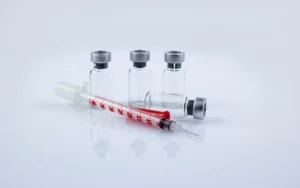






What Is Peptide Therapy? Complete Medical Guide to Healthy Aging
What Is Peptide Therapy? A Complete Medical Guide
What is peptide therapy? Peptide therapy is the medically supervised use of short chains of amino acids — typically 2 to 50 — to support specific cellular repair, growth-hormone signaling, tissue regeneration, and metabolic pathways that decline with age. When people ask what peptide therapy is, they are usually asking one honest question: is this the real thing, or another wellness trend? The short answer is that peptides prescribed by a provider after an evaluation, and dispensed by a licensed, accredited compounding pharmacy, are a very different thing from what is sold online.
If you have been told your labs look “normal” but you still feel like your recovery, sleep, skin, and energy are aging faster than you are, you are not imagining it. Standard reference ranges describe the population, not the optimal range for how you actually want to feel. Peptides work upstream of that gap.
Key Takeaways
- Peptides are short amino-acid chains that act as precise cellular signals — they instruct the body rather than override it.
- Growth hormone secretagogues such as CJC-1295 with ipamorelin are designed to support the body’s own pulsatile growth hormone release rather than replace it.
- Tissue-repair peptides such as BPC-157 are studied for their role in blood-vessel formation and growth-factor signaling.
- Peptides dispensed by a licensed, accredited compounding pharmacy operate under state pharmacy board oversight — gray-market products do not.
- Candidacy at Balanced Aesthetics + Wellness is decided by your provider after a consultation and, where recommended, bloodwork, not by symptom checklists.
What peptides actually are
Peptides are short chains of amino acids — the same building blocks that make up every protein in your body. A protein is typically 50 or more amino acids folded into a complex structure. A peptide is smaller, more targeted, and biologically active in ways your cells already recognize.
Your body already makes hundreds of peptides. Therapeutic peptides don’t introduce something foreign — they replicate or reinforce signals that decline with age.
Insulin is a peptide. Oxytocin is a peptide. Growth hormone-releasing hormone is a peptide. What clinical peptide therapy does is deliver a specific sequence, chosen by your provider based on your labs, to support a signal that has faded over time.
How peptides work at the cellular level
Peptides work by binding to specific receptors on the surface of your cells, triggering a downstream cascade — gene expression shifts, growth factors release, and repair pathways activate. Because each peptide targets a distinct receptor family, the effect is designed to be targeted rather than broad.
That last point is the one most consumer content misses. If you take a growth hormone secretagogue every day forever, your pituitary receptors become less responsive. The dose stops working. A properly designed plan respects that biology.
The peptide categories that matter for optimal aging
The peptides used in optimal-aging plans fall into four functional categories: growth hormone secretagogues (overnight recovery support peptides), tissue repair peptides, metabolic peptides, and cognitive/longevity peptides. Balanced Aesthetics + Wellness uses each based on what a client’s comprehensive panel and goals actually indicate — not on a menu.
Growth hormone secretagogues
CJC-1295 combined with Ipamorelin is designed to stimulate pulsatile growth hormone release. Growth hormone levels decline gradually with age, which is one of several factors that can influence recovery, sleep, and body composition.
Your provider decides which option, if any, suits you, including sermorelin, the older, shorter-acting option. Changes in sleep, recovery, and body composition are reviewed at follow-up. Individual results vary.
Tissue repair peptides
BPC-157 (Body Protection Compound) is studied for its effects on blood-vessel formation and growth-factor signaling, and for its role in gut, tendon, and post-injury tissue repair. Research is ongoing, and peptides dispensed by a licensed, accredited U.S. compounding pharmacy under medical oversight are not FDA-approved. TB-500 is also studied for its role in muscle recovery and tissue repair.
The peptides that get talked about the most on social media are not always the ones that fit a given client. The peptides that matter are often less exciting, and your provider chooses among them based on your labs and goals.
Metabolic and cognitive peptides
NAD+ is technically a coenzyme rather than a peptide, but it belongs in the same conversation — NAD+ levels decline progressively with age, and NAD+ therapy is used to support healthy levels. Semax and Selank support cognitive resilience through different mechanisms and are used selectively, again based on lab context and client goals.
Licensed pharmacy vs. gray-market sourcing
The single largest risk in peptide therapy is not the peptides themselves — it is where they come from. Some independent testing of gray-market peptides sold as “research chemicals” has reported contamination with heavy metals, bacterial endotoxins, incorrect amino-acid sequences, and inaccurate dosing.
| Factor | Gray-market “research” peptides | Licensed, accredited compounding pharmacy |
|---|---|---|
| Regulatory oversight | None | State pharmacy boards |
| Sequence verification | Rarely tested | Certificate of analysis per batch |
| Sterility testing | Inconsistent | Required and documented |
| Prescriber involvement | None — sold direct | Provider-prescribed after evaluation |
| Dose accuracy | Highly variable | Verified to specification |
Every peptide at Balanced Aesthetics + Wellness is dispensed by a licensed, accredited compounding pharmacy operating under state pharmacy board oversight. Peptides dispensed by a licensed, accredited U.S. compounding pharmacy under medical oversight are not FDA-approved. It is more expensive. It is also the only version of this therapy that is honestly defensible.
What a real plan looks like
A legitimate peptide plan at Balanced Aesthetics + Wellness begins with an honest consultation with your provider, plus bloodwork where recommended — not a peptide-of-the-month recommendation. From there, plans are personalized around three variables: which pathways your labs indicate are underperforming, what you are actually trying to change, and how your body responds over the first phase.
Your provider sets the length of each phase and any break between rounds. Progress is reviewed at follow-up, and the plan is adjusted if it isn’t doing what it should. This is not a subscription; it is supervised medical care.
Who peptide therapy is (and is not) for
Peptide therapy is most appropriate for adults 30+ whose labs show declining growth hormone signaling, poor recovery markers, or specific repair needs — and who are willing to do the lifestyle work alongside the plan. Your provider may recommend against it if you have an active malignancy, and it is not a shortcut for people who don’t sleep, don’t train, and don’t eat protein.
- Recovery from training has slowed noticeably over the last several years.
- Sleep is technically enough hours but doesn’t feel restorative.
- Skin quality, body composition, or gut function has shifted despite consistent habits.
- You’ve been told your labs are “normal” and left without a plan.
If any of those describe you, the conversation starts with data. That’s what the consultation and the panel are for — to figure out whether peptides are the right lever for your specific biology, or whether hormone optimization, metabolic support, or something else should come first.
Frequently asked questions
How quickly do peptides work?
There is no fixed timeline. Response depends on the peptide, your age, your baseline, and your lifestyle, which is why your provider reviews progress at follow-up rather than relying on how you feel alone. Individual results vary.
Are peptides safe long-term?
Safety depends on sourcing, supervision, and your own history, which is why peptides here are prescribed only after a provider evaluation and monitored over time. The risks that make headlines almost always trace back to gray-market products, unsupervised dosing, or peptides used indefinitely without planned breaks. That’s why every plan at Balanced Aesthetics + Wellness is lab-driven, with breaks your provider sets — and why sourcing is non-negotiable.
Do I need bloodwork before starting?
Your provider decides. When bloodwork is recommended, our panel covers 60+ biomarkers — and it is not a formality. Labs tell us which pathways are actually underperforming, whether hormone optimization should come first, and what to monitor as the plan runs. Recommending peptides without labs is guessing, and guessing isn’t medicine. Book a consultation and we’ll map out the right panel for your goals.
Can I combine peptides with hormone therapy or GLP-1 medications?
Sometimes, when your provider decides the combination fits your plan. Peptides, hormone optimization, and medically supervised weight management address different pathways, and a full-spectrum treatment plan considers all of them together. What that looks like for you depends on your labs, your history, and your goals, which is exactly what the consultation is for.
Peptide therapy is not a shortcut, and it is not a fringe. It is a provider-supervised way to support signals that fade with age — when it’s prescribed after a real evaluation, dispensed by a licensed, accredited compounding pharmacy, and run with the breaks your provider sets. Whether it’s the right lever for you depends on what your panel shows and what you’re trying to change. Book a consultation and we’ll figure that out together.
Medically reviewed by Dr. Kimberly Gilbert, MD — Medical Director, Balanced Aesthetics + Wellness
 Previous Post
 Next Post